IVF Cost in India 2026: City-Wise Breakdown, Clinic Comparison & Hidden Charges
If you are searching for IVF cost in India, you have probably noticed that no two clinics quote the same number. One clinic says ₹80,000. Another says ₹4,00,000. Both are for “IVF.” Both are in the same city. That confusion is not an accident, and understanding why costs vary this much is the most important thing you can do before spending a single rupee.
As someone who has spent years of working with IVF clinics, plastic surgeons and fertility specialists across India, I have seen couples overpay by lakhs, not because they were careless, but because no one gave them an honest breakdown before they started. Healthytips4Us this guide does exactly that.
What is IVF? A Quick Overview
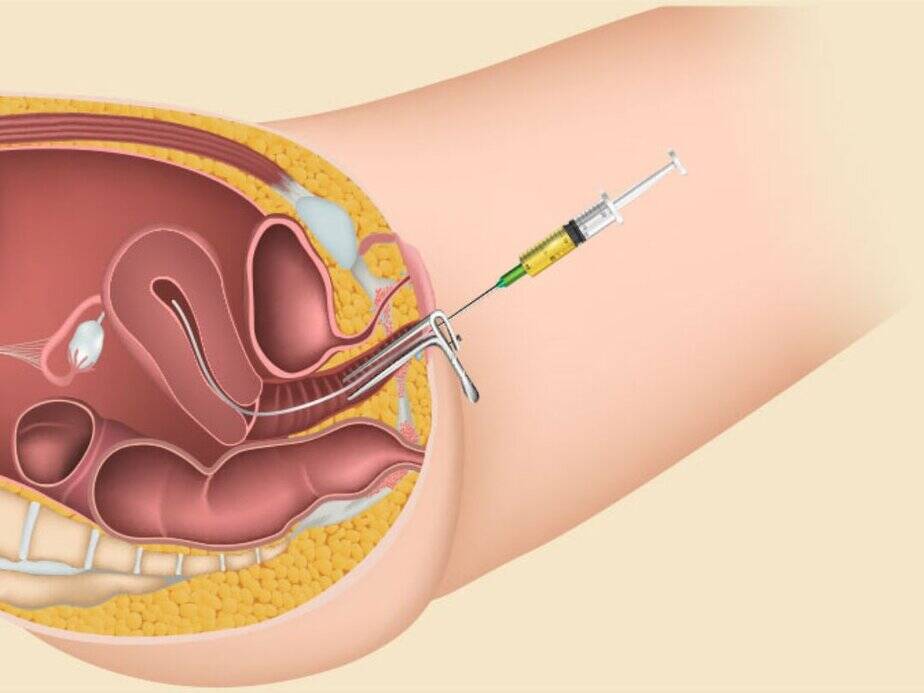
IVF, or In Vitro Fertilisation, is an assisted reproduction procedure where eggs are retrieved from a woman’s ovaries, fertilised with sperm in a laboratory, and the resulting embryo is transferred to the uterus. A single IVF cycle typically takes 4–6 weeks from the start of hormonal stimulation to embryo transfer. It is the most widely used ART (Assisted Reproductive Technology) procedure in India, with over 2.5 lakh IVF cycles performed annually according to ICMR data.
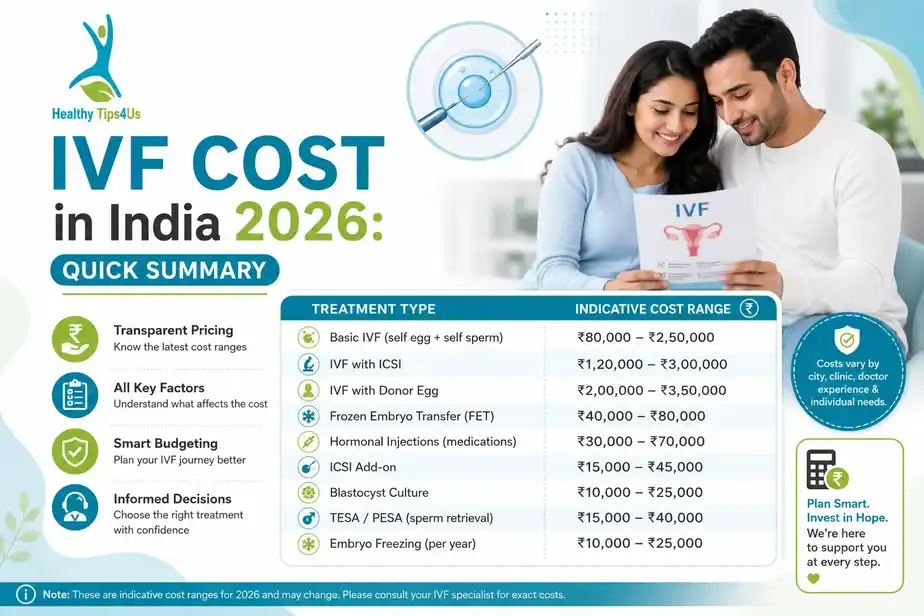
IVF Cost in India 2026: Quick Summary
| Treatment Type | Indicative Cost Range |
| Basic IVF (self egg + self sperm) | ₹80,000 – ₹2,50,000 |
| IVF with ICSI | ₹1,20,000 – ₹3,00,000 |
| IVF with Donor Egg | ₹2,00,000 – ₹3,50,000 |
| Frozen Embryo Transfer (FET) | ₹40,000 – ₹80,000 |
| Hormonal Injections (medications) | ₹30,000 – ₹70,000 |
| ICSI Add-on | ₹15,000 – ₹45,000 |
| Blastocyst Culture | ₹10,000 – ₹25,000 |
| TESA / PESA (sperm retrieval) | ₹15,000 – ₹40,000 |
| Embryo Freezing (per year) | ₹10,000 – ₹25,000 |
Note: These are indicative ranges based on publicly available data (2026). Actual cost depends on your diagnosis, age, number of cycles, and clinic. Always request an itemised quote directly from the clinic.
Why Does IVF Cost Vary So Much in India?
This is the question most websites avoid answering clearly. After working closely with fertility clinics across multiple cities, here are the four factors that genuinely determine what you will pay:
-
Clinic Reputation and Patient Reviews
A clinic’s reputation is built over years of successful outcomes, and it is priced accordingly. Branded networks like Birla Fertility, Nova IVF, and Bloom IVF invest in international-standard labs, embryologist training, and quality assurance systems that smaller standalone clinics simply cannot match.
What to do: Do not rely solely on the clinic’s own website testimonials. Check Google Reviews, Practo ratings, and fertility forums. Look specifically for reviews from patients who had multiple failed cycles at the clinic — how the clinic handled those situations tells you far more than the success stories.
A clinic with 4.8★ from 50 reviews means far less than one with 4.3★ from 2,000 reviews.
-
Doctor’s Expertise and Track Record
This is the single most underestimated cost factor. Two IVF specialists in the same city, using the same equipment, can have dramatically different success rates — because embryology and ovarian stimulation protocols require deep, procedure-specific experience.
What to ask every clinic
- How many IVF deliveries has the lead embryologist personally managed?
- What is the clinic’s live birth rate (not just pregnancy rate) for women in your age group?
- Will the same doctor manage your entire cycle or will you be handed off to a junior?
- How does the doctor communicate — do they explain each step or rush through consultations?
Behaviour matters. A doctor who takes 20 minutes to explain your protocol will almost always deliver better outcomes than one who hands you a pamphlet. The emotional burden of IVF is heavy enough — you deserve a physician who treats you as a person, not a case number.
-
Single-Cycle vs Multi-Cycle Package Pricing
This is where many couples get caught off guard. Some clinics quote a base price per cycle. Others offer 2-cycle or 3-cycle packages at 15–25% discount. On the surface, multi-cycle packages look like great value.
The reality: Approximately 60–65% of first IVF cycles do not result in a live birth. Most couples need 2–3 cycles. A 3-cycle package at ₹3,00,000 total sounds cheaper than ₹1,50,000 per cycle — but if you succeed in the first cycle, you have overpaid.
What to do: Ask specifically whether the package price is refunded if you succeed early. Also ask whether medications are included or billed separately per cycle — this changes the true cost significantly.
-
Post-Care and Follow-Up Support
Post-transfer care is often the most neglected — and most critical — phase of IVF. After embryo transfer, you need regular monitoring (progesterone levels, ultrasounds, beta-HCG tests) for at least 2 weeks.
Not all clinics include this in the quoted package. Some charge ₹500–₹2,000 per follow-up visit separately.
Why this matters: Poor post-transfer monitoring is one of the primary reasons for implantation failure that goes undetected. Always ask: “What does post-transfer care look like, and is it included in the quoted price?”
Clinics that provide a dedicated coordinator, accessible via WhatsApp or phone for the 2 weeks post-transfer, signal a genuinely patient-centric approach.
City-Wise IVF Cost in India 2026
Metro cities typically cost 15–25% more than Tier-2 cities — primarily due to higher clinic rent, lab infrastructure, and senior specialist fees. This does not mean higher cost equals better success rates, but it does mean the choice of city matters to your budget.
IVF Cost In Delhi NCR
Delhi is India’s IVF hub, home to the highest concentration of specialised fertility clinics and some of the country’s most experienced embryologists. Gurgaon clinics tend to run 15–20% higher than central Delhi for the same procedures.
| Clinic | Price Range | Key Strength | Website |
| Birla Fertility | ₹1,71,000 – ₹4,17,000 | Transparent pricing, premium labs | birlafertility.com |
| Aveya IVF | ₹1,00,000 – ₹2,00,000 | All-inclusive packages, 3 locations | aveya.in |
| RiSaa IVF | ₹1,50,000 – ₹2,50,000 | Dr. Rita Bakshi, strong success rates | drritabakshi.in |
| Prime IVF | ₹85,000 – ₹1,50,000 | No hidden charges, Dwarka & Gurgaon | primeivfcentre.com |
| Indira IVF | ₹80,000 – ₹1,30,000 | Most affordable, EMI available | indiraivf.com |
Expert tip: If you live in Noida, opt for a clinic on the east side of Delhi rather than travelling to South Delhi, during the stimulation phase, you visit the clinic every 2–3 days. 90 minutes each way in Delhi traffic adds up quickly and increases stress during an already demanding period.
IVF Cost In Mumbai
Mumbai is typically India’s most expensive city for IVF, with operational costs driving prices 20–30% above the national average. That said, Mumbai is home to some of the country’s most experienced IVF pioneers.
| Clinic | Price Range | Key Strength | Website |
| Bloom IVF | ₹1,00,000 – ₹2,50,000 | 35+ years experience, pioneered blastocyst culture in India | bloomivf.com |
| Nova IVF | ₹1,50,000 – ₹3,00,000 | Established national chain | novaivffertility.com |
| Birla Fertility | ₹2,00,000 – ₹4,50,000 | Premium infrastructure | birlafertility.com |
| Cloudnine Hospital | ₹1,25,000 – ₹3,00,000 | Excellent technology, embryologist quality | cloudninecare.com |
IVF Cost In Bangalore
Bangalore offers an excellent balance of cost and technology. Its large IT-sector workforce has driven strong investment in fertility infrastructure, making it one of the most competitive markets in India for IVF quality.
| Clinic | Price Range | Key Strength | Website |
| Nova IVF | ₹1,50,000 – ₹3,50,000 | Strong reputation with IT couples | novaivffertility.com |
| Apollo Fertility | ₹1,00,000 – ₹3,60,000 | Hospital-grade infrastructure | apollofertility.com |
| Indira IVF | ₹80,000 – ₹1,30,000 | Budget-friendly, widespread | indiraivf.com |
IVF Cost In Hyderabad
Hyderabad’s fertility market has grown significantly over the last 5 years, with established national chains opening dedicated units and local specialists offering high quality at competitive prices.
| Clinic | Price Range | Key Strength | Website |
| Continental Hospitals | ₹1,20,000 – ₹3,00,000 | Specialised fertility unit, expert embryologists | continentalhospitals.com |
| Apollo Fertility | ₹1,00,000 – ₹3,00,000 | Multi-specialty hospital backing | apollofertility.com |
| Indira IVF | ₹80,000 – ₹1,30,000 | Affordable, widely trusted chain | indiraivf.com |
IVF Cost In Chennai
Chennai is the fertility hub for South India, with some of the strongest hospital-backed fertility programs in the country. Costs here are generally 10–15% lower than Mumbai or Delhi for comparable quality.
| Clinic | Price Range | Key Strength | Website |
| Apollo Fertility | ₹1,20,000 – ₹3,00,000 | South India’s strongest brand | apollofertility.com |
| Nova IVF | ₹1,20,000 – ₹2,80,000 | Established chain | novaivffertility.com |
| Sudha Fertility Centre | ₹90,000 – ₹2,00,000 | Transparent, affordable, South India focus | sudhafertilitycentre.com |
Tier-2 City Comparison
| City | Key Clinics | Price Range | Notes |
| Pune | Progenesis Fertility, Nova IVF, Indira IVF | ₹1,00,000 – ₹2,50,000 | Progenesis includes medications in package |
| Kolkata | Care IVF, Nova IVF, Birla Fertility | ₹1,00,000 – ₹2,50,000 | Shorter waiting times than metros |
| Jaipur | Indira IVF HQ, Alka IVF, SMS Hospital (Govt ₹20,000) | ₹80,000 – ₹2,00,000 | 40–50% cheaper than Delhi |
| Ahmedabad | IKDRC (Govt ₹30,000), Indira IVF, Crysta IVF | ₹80,000 – ₹2,50,000 | Best govt IVF programme in India |
| Lucknow | Mayo IVF, SGPGI (Govt), Indira IVF | ₹70,000 – ₹2,00,000 | Government options available |
| Chandigarh | PGIMER (Govt), Indira IVF, Bloom IVF | ₹85,000 – ₹2,00,000 | PGIMER has long wait but excellent outcomes |
Websites:progenesisfertility.com | careivf.com | dralkaivf.com | crystaivf.com | pgimer.edu.in
Pro Tip: For couples in Delhi NCR, Jaipur is just 5 hours by train and offers IVF at 40–50% lower cost. Indira IVF’s headquarters is in Jaipur, meaning you get their best senior team, not a branch clinic. Several metro couples specifically travel to Jaipur for IVF cycles.
ICSI, TESA & PESA: When Are They Recommended and Why Do They Cost More?
These three procedures are add-ons to standard IVF. They are recommended for specific diagnoses and add ₹15,000–₹50,000 to the total cost. Understanding when each is needed, and why they cost more, is essential before you sign a treatment plan.
ICSI (Intracytoplasmic Sperm Injection)
What it is: Instead of placing sperm near the egg in a dish (standard IVF), in ICSI a single healthy sperm is directly injected into the egg using a microscopic needle.
When it is recommended:
- Low sperm count (oligospermia) — less than 15 million/mL
- Poor sperm motility (less than 40% moving)
- High percentage of abnormal sperm morphology
- Previous IVF cycles with poor or zero fertilisation
- Frozen or surgically retrieved sperm (TESA/PESA)
- Unexplained repeated implantation failure
Why it costs more (₹15,000 – ₹45,000 extra): ICSI requires an additional highly trained embryologist, a separate specialist whose only role is to perform the microinjection under a high-powered microscope. The procedure requires specialised ICSI-certified lab equipment (micromanipulator, inverted microscope) that not every IVF lab has. The skill level required is significantly higher than standard IVF fertilisation.
TESA (Testicular Sperm Aspiration)
What it is: A fine needle is inserted into the testis under local anaesthesia to aspirate sperm directly from testicular tissue.
When it is recommended:
- Obstructive azoospermia (no sperm in ejaculate due to a blockage — post-vasectomy, post-infection, congenital absence of vas deferens)
- When sperm cannot be collected through standard ejaculation
- As a backup in cases of severe ejaculation dysfunction
Why it costs more (₹15,000 – ₹35,000 extra): TESA is a minor surgical procedure requiring local anaesthesia, a urologist, and a recovery period. The retrieved sperm is typically in very small quantities and must be immediately processed by an andrologist in the lab. It almost always requires ICSI to use the retrieved sperm, so the costs combine.
PESA (Percutaneous Epididymal Sperm Aspiration)
What it is: Sperm is aspirated from the epididymis (the tube behind the testis where sperm matures) rather than the testis itself, using a fine needle.
When it is recommended:
- Obstructive azoospermia where sperm is present in the epididymis but cannot reach the ejaculate
- Post-vasectomy patients where reversal has failed
- Congenital bilateral absence of the vas deferens (CBAVD)
- Preferred over TESA when epididymal sperm is accessible, as epididymal sperm is typically more mature
Why it costs more (₹20,000 – ₹40,000 extra): Like TESA, PESA requires surgical skill, anaesthesia, and immediate lab processing. The combination of PESA + ICSI adds approximately ₹35,000–₹80,000 to the total IVF cost. Some clinics include one sperm retrieval attempt in their base package, always ask explicitly whether TESA/PESA is included before committing.
ICSI vs TESA vs PESA: Quick Reference
| Procedure | Used For | Additional Cost | Required with |
| ICSI | Poor sperm quality/quantity | ₹15,000 – ₹45,000 | Standard IVF |
| TESA | No sperm in ejaculate (testicular retrieval) | ₹15,000 – ₹35,000 | Always with ICSI |
| PESA | No sperm due to blockage (epididymal retrieval) | ₹20,000 – ₹40,000 | Always with ICSI |
Hidden Charges Most Clinics Do Not Mention Upfront
Based on real patient experiences across multiple clinics, these are the costs that regularly appear mid-treatment and shock unprepared couples:
- Hormonal injections (₹30,000 – ₹70,000) The single biggest hidden cost. Many clinics quote a “base IVF price” that explicitly excludes medications. Stimulation injections like Gonal-F and Menopur are expensive and non-negotiable. Always ask: “Does your quoted price include all injections?”
- Monitoring scans during stimulation (₹500 – ₹2,000 each) During the 10–12 day stimulation phase, you need an ultrasound every 2–3 days. That is 4–6 scans. Many clinics bill these separately. Ask whether monitoring is included.
- Anaesthesia for egg retrieval (₹5,000 – ₹15,000) Egg retrieval is performed under sedation. Some clinics include anaesthesia in the package. Others bill it separately from a separate anaesthetist.
- Embryo freezing beyond the first embryo (₹10,000 – ₹25,000 per year) If you have surplus good-quality embryos — which is a good outcome — storage costs are billed annually. This is worthwhile for future frozen embryo transfers.
- Post-transfer progesterone support medication (₹5,000 – ₹15,000) Progesterone suppositories or injections post-transfer are standard of care. Not always included in the quoted price.
How to Budget Realistically for IVF in India
Most couples budget for one cycle and are unprepared for the reality that 60–65% of first cycles do not succeed. Here is a realistic total budget framework:
| Scenario | Estimated Total Budget |
| 1 cycle, straightforward case, Tier-2 city | ₹1,20,000 – ₹2,00,000 |
| 1 cycle with ICSI, metro city | ₹1,80,000 – ₹3,00,000 |
| 2–3 cycles (realistic average), metro city | ₹3,50,000 – ₹6,00,000 |
| Complex case with TESA/PESA + ICSI, metro | ₹2,50,000 – ₹4,50,000 per cycle |
Money-saving strategies that do not compromise quality:
- Buy stimulation injections from PharmEasy or 1mg, clinic pharmacy markups are 20–50% over MRP
- Consider Jaipur or Ahmedabad for straightforward cases, same medicine, 40% lower cost
- Ask about 0% EMI, Indira IVF, Nova IVF, and Bajaj Finserv partnerships make this possible
- Register at a government hospital even if you plan private IVF, AIIMS and state hospitals offer subsidised cycles for eligible families
FAQ
-
What is the average IVF cost in India in 2026?
The average cost of one IVF cycle in India ranges from ₹1,50,000 to ₹2,50,000 for a basic self-cycle, excluding medications. Including stimulation injections and standard add-ons, the realistic all-in cost is ₹2,00,000 to ₹3,50,000 per cycle in a metro city.
-
Which is the cheapest city for IVF in India?
Tier-2 cities like Lucknow (₹70,000–₹2,00,000), Jaipur (₹80,000–₹2,00,000), and Ahmedabad (₹80,000–₹2,50,000) offer the lowest costs. Government hospitals in these cities offer IVF from ₹20,000–₹50,000, though waiting periods can be 3–8 months.
-
Is ICSI always necessary with IVF?
No. ICSI is recommended only when there is a male factor issue — poor sperm quality, low count, or abnormal morphology. For couples with normal sperm parameters, standard IVF fertilisation is equally effective and less expensive.
-
Why is IVF so much cheaper at some clinics?
Lower prices often mean medications are excluded, cheaper equipment is used, or less experienced embryologists are employed. A clinic charging ₹50,000 for “IVF” is almost certainly not including medications, monitoring scans, and anaesthesia. Always ask for a fully itemised quote covering all 4–6 weeks of treatment.
-
How many IVF cycles does the average couple need?
Statistically, couples under 35 have a 35–42% live birth rate per cycle. This means 2–3 cycles are needed on average. Women over 38 may require more cycles or consider donor eggs. Budgeting for 2 cycles upfront is the most realistic financial planning approach.
- Does health insurance cover IVF in India?
Most standard health insurance policies in India do not cover IVF. However, some corporate group policies at MNCs now include fertility coverage of ₹1,00,000–₹5,00,000. Some insurers like Star Health offer partial fertility riders. Always check your employer policy specifically — it is increasingly common in IT, banking, and consulting sectors.
- What is the difference between TESA and PESA?
Both retrieve sperm surgically when it is absent in ejaculate. TESA retrieves sperm directly from testicular tissue using a needle. PESA retrieves sperm from the epididymis — the tube where sperm matures. PESA is preferred when sperm is present in the epididymis (e.g., post-vasectomy), as epididymal sperm is more mature. Your urologist will determine which is appropriate based on diagnosis.
- Can I negotiate IVF prices in India?
Yes — particularly for multi-cycle packages. Most clinics will offer 15–25% discount on 2–3 cycle bundles. You can also ask for medications to be included in the package price rather than billed separately. Smaller standalone clinics are generally more flexible on pricing than branded chains.
Abhishek Kumar is the Founder of HealthyTips4us and a Health SEO & Digital Strategy Expert with over 7 years of hands-on experience in the YMYL (Your Money or Your Life) sectors. With a Master’s degree in Biotechnology, he specializes in driving authority for content related to IVF, Dermatology, and Specialized Wellness. His mission is to translate complex, scientific data into trustworthy, actionable health advice.
Read More